Acrylic Fabrication in New York
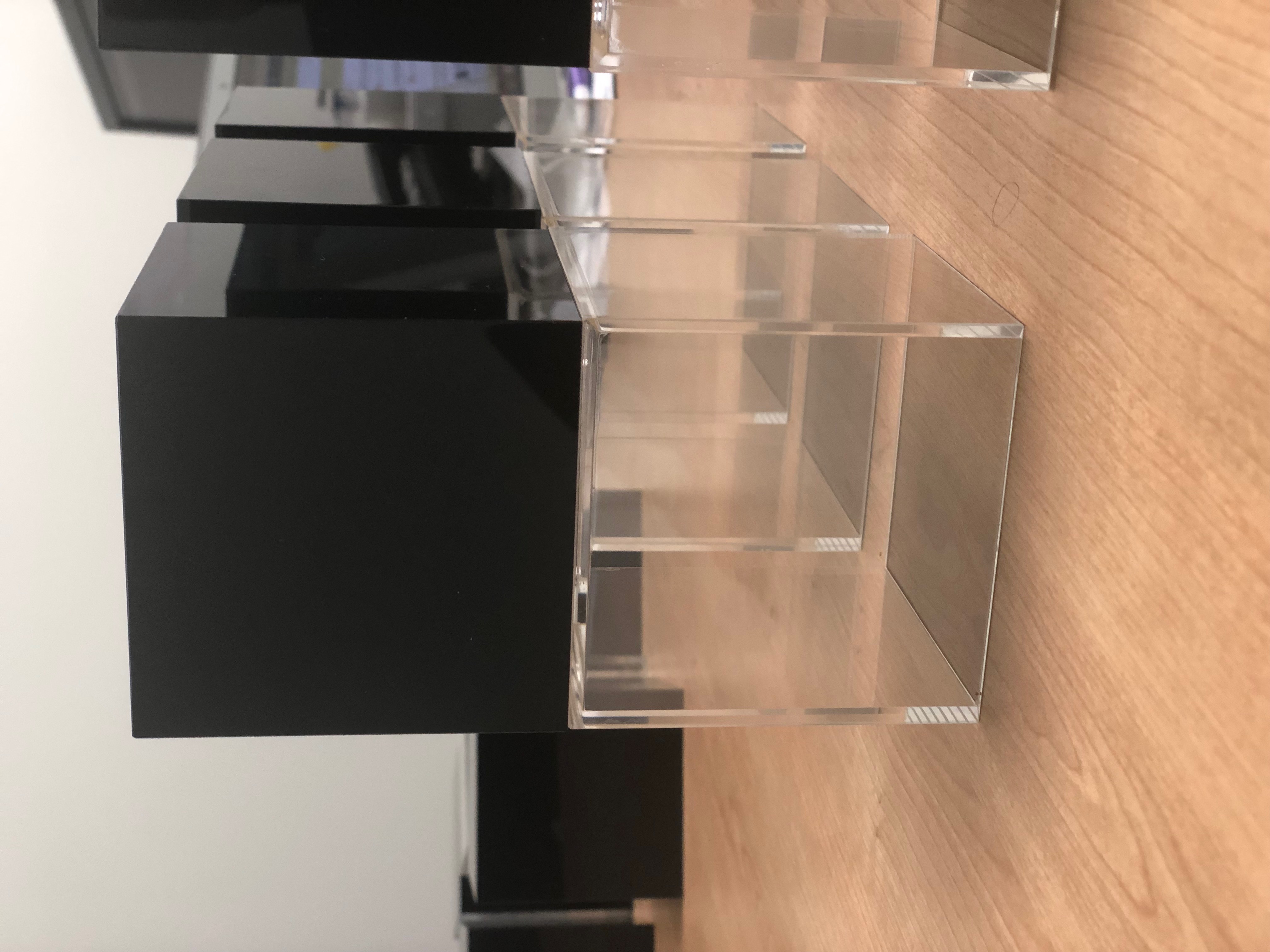
Custom acrylic objects, made to your drawing or your product. Display risers, pedestals, cases and enclosures, holders, covers and guards, cut, formed and bonded in our own workshop in New York. One piece or five hundred.
If the thing you need does not exist, send us a sketch, a photograph or the product it has to hold.
A flat sheet becomes a three-dimensional object
The existing copy has a good line in it that should survive the rewrite: molded, shaped, cut. That is genuinely what this is. A sheet of acrylic arrives flat and leaves as a box, a riser, a case or a cover, and everything interesting about the process happens in between.
Which is also where the quality difference lives. Two acrylic cases can look identical in a photograph and be completely different objects. One has folded corners with no joint at all. The other has four cut edges glued together, and in eighteen months those glued corners will be clouded with fine cracks. Nothing in the picture tells you which is which. The making does.
We cut, form, bond, polish and finish in our own workshop in New York, which is why we would rather talk about the corners than the price.
Objects, not panels
| Category | Examples | Usually for |
|---|---|---|
| Retail display | Risers, tiered displays, plinths, product holders, shelf units, jewelry and cosmetics displays | Stores, showrooms and brand spaces where the product has to sit at the right height. |
| Pedestals and plinths | Freestanding display pedestals in clear, colored or frosted acrylic | Retail, exhibitions, galleries, lobbies and events. |
| Cases and enclosures | Display cases, vitrines, dust covers, locking cases, model and trophy cases | Anything valuable, fragile or dusty that still has to be seen. |
| Holders and dispensers | Brochure and literature holders, menu holders, card and sign holders, table tents | Reception areas, restaurants, showrooms, trade counters. |
| Boxes and containers | Ballot and donation boxes, raffle drums, prize and entry boxes, storage boxes | Events, promotions, activations and fundraising. |
| Guards, screens and covers | Machine guards, splash and equipment guards, counter screens, protective covers | Workshops, labs, kitchens, service counters. Practical, ongoing, unglamorous work. |
| Furniture-adjacent pieces | Lecterns and podiums, small tables, magazine and literature racks | Offices, hotels, events and showrooms. |
| Architectural and light | Light diffusers, panels, infill panels and covers | Interiors, usually working to an architect’s drawing. |
| Acrylic signs and plaques | Flat panels mounted on standoffs | Covered on our acrylic signs page. |
| Acrylic letters | Individual dimensional lettering | Covered on our acrylic letters page. |
Cut, formed, bonded, and the step in between that nobody mentions
Cutting
Laser cutting gives a clear, polished edge straight off the machine and is ideal for thinner sheets and fine detail. CNC routing handles thicker material, cuts shapes a laser cannot and leaves a matte edge that is then polished. Most jobs use both, and which one is used is a decision made for the piece rather than for the machine that happens to be free.
Forming, and why a folded corner beats a glued one
Acrylic can be heated along a line and folded. A riser, a sign holder, a cover or a simple case can often be made from one piece of sheet with no joints at all, and a folded corner is stronger than a bonded one, has nothing to cloud, and simply looks better.
Deeper curves and domes are made by drape or vacuum forming over a tool. That is a different process with a different cost, and it is worth knowing which one a shape needs before the design is finalized, because a shape that can be line-bent is considerably cheaper than one that cannot.
Bonding
Where pieces do have to be joined, they are solvent bonded rather than glued in any ordinary sense. The solvent softens both surfaces and they fuse, and done properly the joint is close to invisible. Done badly it traps bubbles, runs, or clouds, and none of that can be fixed afterwards.
Annealing, which is the answer to the crazed corner
Cutting and machining acrylic leaves stress in the material. If solvent is then applied to a stressed edge, it attacks it, and over the following months a network of fine cracks develops along the joint. That is crazing, it looks like permanent frost in the corners, and it cannot be polished out. It is why so many acrylic boxes and cases look cloudy at the edges after a year or two.
If you are comparing quotes for a bonded acrylic piece, ask whether the parts are annealed before bonding. The answer explains most price differences on this product.
Finishing
Edges are flame or diamond polished where they are seen. Faces can be printed, screen printed, engraved or have applied vinyl. Acrylic comes in clear, colored, frosted and mirror finishes, and a single piece often uses more than one.
| Page | It owns | The one-line test |
|---|---|---|
| Acrylic fabrication (this page) | Three-dimensional acrylic objects. Risers, pedestals, cases, holders, boxes, guards. | Does it have more than one face and hold, cover or contain something? |
| Acrylic signs | Flat panels and plaques mounted on standoffs. | Is it a panel on a wall? |
| Acrylic letters | Individual dimensional letters and logos. | Is it letters with no background? |
| POP displays | Campaign merchandising programs, usually printed, usually temporary and replaced. | Does it change with the promotion? |
| Store fixtures | The retail furniture and fixturing program for a whole store. | Is it the store, rather than a piece in it? |
The same drawing, at any quantity
Most acrylic fabrication starts as one of something. A prototype, a single case for one product, a riser to see whether the idea works on a shelf. Then either it stays at one, or it becomes fifty for a rollout.
- Prototype first. We will make one before we make fifty. It costs more per piece and it is almost always worth it, because the things you want to change are things you only notice when it is in front of you.
- Where the volume changes things. Small quantities are cut and fabricated directly. Larger runs can justify tooling for forming, which changes the economics. We will tell you where your quantity falls before you commit to a design.
- Repeatable. We hold the drawing and the specification, so the next twenty match the first twenty, and a replacement for a cracked panel in two years is a repeat rather than a reverse-engineering exercise.
- Repairable, where it matters. A bonded acrylic case that gets knocked usually loses one panel, not the whole case. Where it makes sense we build so a single face can be replaced.
Sketch to finished piece
- Send us what you have. A sketch, a photograph, a drawing, or the product it has to hold. Any of them is enough to start, and the object itself is the most useful of the four.
- Four questions. What it holds, where it lives, whether it gets handled, and how many. Those four answers decide material, thickness and construction.
- Drawing. Drawn up properly, with the construction decided: what is folded, what is bonded, what is removable.
- Prototype. One piece, checked in place before the rest are made. This is the step that saves money rather than costing it.
- Made. Cut, machined, annealed, formed, bonded, polished and finished in our workshop.
- Delivered. Delivered, or installed where it needs fixing down. We keep the drawing for the next order.
Cut, formed and bonded here
| Capability | What it means for your piece |
|---|---|
| We anneal before bonding | The step that stops joints crazing. Invisible in the finished piece, and the first thing a cheaper supplier leaves out. |
| We fold rather than glue | Where a piece can be formed from one sheet, it is. Fewer joints, stronger, and nothing to cloud. |
| We prototype | One before fifty, so the changes happen on the cheap one. |
| We make it here | Cut, formed, bonded, polished and finished in our own New York workshop, so lead times are short and a change is a conversation. |
| We keep the drawing | The next order matches, and a replacement panel is a repeat rather than a new job. |
| We work from anything | A sketch, a photograph, a CAD file or the product itself. |
Frequently Asked Questions About Acrylic Fabrication
What is acrylic fabrication?
Acrylic fabrication is the process of turning a flat acrylic sheet into a three-dimensional object by cutting, heating and forming, and bonding. It covers display risers, pedestals, cases and enclosures, holders, boxes, guards and covers. Flat panel signs and dimensional letters are also made from acrylic but are different products; see our acrylic signs and acrylic letters pages.
Why do some acrylic boxes go cloudy at the corners?
That is crazing, and it is caused by solvent bonding parts that still have machining stress in them. The cure is annealing, which means heating the machined parts and cooling them slowly before they are bonded, so the stress is relieved first. It adds hours to the job, it is invisible in the finished piece and it is the first step dropped when something is made down to a price. If you are comparing quotes, ask whether the parts are annealed.
Can you make just one?
Yes, and one is often the right place to start. A single prototype costs more per piece and it is almost always worth it, because the things worth changing are the things you only notice with the object in front of you. We keep the drawing, so going from one to fifty later is straightforward.
I do not have a drawing. What can you work from?
A sketch on paper, a photograph of something similar, a CAD file, or the product itself sent to us. The product is the most useful of the four, because a piece made to fit something specific is measured from that thing rather than from a dimension somebody wrote down.
Acrylic or glass for a display case?
Acrylic for almost anything that gets moved, is large, or sits where it could be knocked, because it is about half the weight and does not shatter. Glass where the case will be static and people will touch it, because glass is much harder to scratch. Our acrylic signs page has a fuller comparison of the two materials.
What thickness do I need?
It depends on the span and the load more than on the look. A shelf carrying weight needs more than a panel that carries nothing, and an unsupported span will bow over time if it is underspecified. Tell us what it holds and how big it is and we will specify it.
Can it be printed or engraved?
Yes. Acrylic can be printed digitally or screen printed, engraved, or finished with applied vinyl, and sheet comes in clear, colored, frosted and mirror finishes. Branding a fabricated piece is normal and it is usually done before assembly.
Do you still make protective screens and guards?
Yes. Machine guards, splash guards, equipment covers and counter screens are ongoing work, made to fit the machine, counter or bench rather than bought off a shelf. Send us the dimensions or a photograph.
View Our Projects