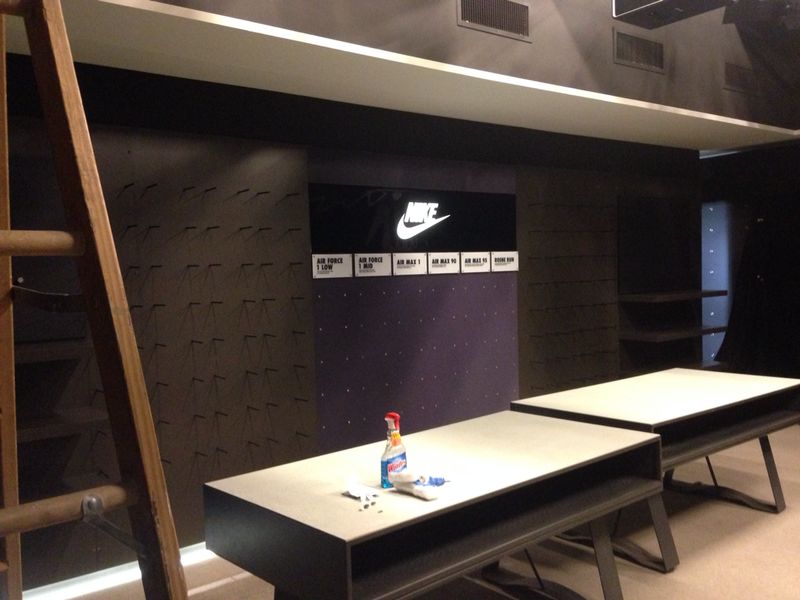
Store Fixtures in New York
Velement designs, fabricates and installs custom store fixtures for New York retail. Shelving, gondolas, counters, cash wraps, display cases, plinths and shop fittings, built in our own workshop to fit your space rather than ordered from a catalog and made to do.
Single-store fit-outs, flagship builds and multi-location rollouts. Design, fabrication, delivery and installation from one team, scheduled around your opening date.
Fixtures decide how a store works, and when it opens
Store fixtures are the part of a retail build that everything else waits for. They hold the stock, they set the aisles, they decide where customers walk and where they stop, and they are almost always the longest lead item in the program. A fit-out with the flooring down, the lighting in and no fixtures is a store that cannot open.
They are also the part of the store that gets treated the worst. Fixtures are leaned on, loaded past their rating, dragged across floors, hit by carts and restocked several times a day for years. A fixture that looks right on the day it is installed and sags, marks or wobbles six months later is a fixture that was specified for a photograph rather than for a shop.
Velement makes store fixtures in its own workshop in New York. That means they are built to the building rather than adjusted to it, made in sections that will actually reach the floor they are going to, and matched to the signage and graphics in the same space because those come from the same place.
Store fixtures we make
Floor and wall
| Fixture | What it does | Typically made from |
|---|---|---|
| Gondolas and wall bays | The backbone of most stores. Runs of adjustable shelving against a wall or back to back on the floor. | Laminated board or powder-coated steel, with adjustable shelf supports. |
| Freestanding floor units | Islands and mid-floor units that break up the space and create the route customers walk. | Laminated board, timber, steel or a combination, usually on leveling feet. |
| Slatwall and slotted systems | A flexible wall face that accepts shelves, arms, rails and hooks in any arrangement. | Grooved panel with metal inserts where the load needs it. |
| Hanging rails and arms | Apparel presentation, face-out or side-on. | Steel or brass-finished tube, wall-mounted or on a floor unit. |
| Plinths and pedestals | Raises single products or mannequins out of the run. | Painted board, acrylic or fabricated metal. Also see our acrylic fabrication. |
Counters, cases and service
| Fixture | What it does | Typically made from |
|---|---|---|
| Cash wrap and POS counter | The transaction point, and usually the most-used piece of furniture in the store. | Board carcass with a hard-wearing worktop and a durable, replaceable front face. |
| Display cases | Secures and presents high-value products while keeping it visible. | Glass and metal or glass and board, with locks and integrated lighting. |
| Back counters and back bar | Storage, equipment and brand presence behind the service line. | Board or metal, built to the wall and to the equipment it has to house. |
| Fitting room fixtures | Benches, hooks, rails, mirrors and the joinery around them. | Timber or board with impact-resistant edges. |
| Product-specific merchandisers | Units built around one product type: eyewear, footwear, cosmetics, spirits, electronics. | Whatever the product needs. This is the work that cannot be bought from a catalog. |
Why New York fit-outs go wrong, and what we do differently
A store fixture is not furniture. It has to get into the building, sit level on a floor that is not, and fix to walls that were built before anyone thought about fixings. In New York that is not an edge case, it is most jobs.
- Access. Fixtures have to reach the floor they are going to. A unit that fits the store perfectly and does not fit the freight elevator, the stairwell or the front door is scrap. We measure the route as well as the space, and build in sections that will make the journey and assemble on site.
- Floors. Very few older retail floors in the city are flat. Fixtures built as rigid boxes and set on an uneven floor rock, twist and open at the joints. Leveling feet and a build tolerance are specified from the start rather than corrected with packers on installation day.
- Walls. Masonry, stud, furring, brick, plaster over anything. What a fixture can be fixed to determine how it has to be built, and it is established on the site visit rather than discovered by an installer with the store opening in two days.
- Deliveries. Loading dock, or no loading dock. Overnight access, or a delivery window. Building management, elevator booking, certificates of insurance. It is part of the job and we plan it rather than discovering it.
Specify for five years, not for the opening photograph
| What goes wrong | Why | What we specify instead |
|---|---|---|
| Shelves bow | Loaded past what the span and the material can carry. A shelf rated for folded apparel will sag under bottles or books. | Span, thickness and support set against the actual product weight, with reinforcement where the load is genuinely heavy. |
| Edges chip and peel | Ankle and hip height take constant impact from carts, bags and restocking. | Impact-resistant edging on every exposed edge below waist height, and materials chosen for the level they sit at. |
| Finishes wear through | Hands, sleeves and product passing the same spot thousands of times a week. | Hard-wearing laminates and finishes on contact surfaces, with the wearing face specified to be replaceable where it makes sense. |
| Units wobble | Uneven floor, no leveling, or a unit built too light for the load it ended up carrying. | Leveling feet as standard, and a carcass built for a fully loaded unit rather than an empty one. |
| Adjustment stops working | Shelf supports and brackets that were adequate on day one and are not after two hundred changes. | Metal support systems in anything that will actually be adjusted, not molded plastic. |
Three things retailers ask for using the same words
These get used interchangeably and quoted wrongly more often than any other three terms in retail. The difference is permanence and who is paying.
| Question | Store fixtures | POP displays | In-store signage displays |
|---|---|---|---|
| What it is | Permanent fixtures that hold stock and form part of the store. | A temporary unit promoting one product or brand. | Signage and communication on the shop floor. |
| Who usually pays | The retailer, as part of the fit-out. | The brand, as part of a campaign. | Either. |
| How long it lasts | Years. | Weeks to months. | The length of the campaign. |
| What it is made from | Board, metal, glass and timber, built to last. | Often board or lighter materials, designed to be assembled and disposed of. | Print, panel and vinyl. |
| If you need | Somewhere for your stock to live. | To promote one line for a season. | To tell customers something. |
Velement makes all three, so this is a genuinely helpful table rather than a sales filter. If you are not sure which you need, describe the problem and we will tell you.
Fixtures decide whether a store is accessible
Aisle widths, counter heights and reach ranges are set by where the fixtures go and how tall they are, which makes accessibility a fixture decision rather than a signage one. Two things are worth knowing before a layout is drawn.
- Aisles and routes. Fixtures determine the clear width of every route through the store. A layout that works on a drawing and leaves a route too narrow once the units are loaded is a layout that has to be moved.
- Sales and service counters. The ADA Standards set requirements for sales and service counters, including a portion at an accessible height. This is a counter specification, and it is far cheaper to build in than to correct after a counter is installed and wired.
We check the layout against the requirements at the drawing stage, as part of the project.
From floor plan to opening day
- Scope and schedule. We work from your floor plan, your product and your opening date. Fixtures are usually the critical path, so the date drives everything that follows.
- Site survey. Measured survey of the space, the walls, the floor levels and the access route into the building.
- Design and specification. Layout, fixture schedule, materials and finishes, shown as drawings and, where it helps, a sample of the finish before anything is committed.
- Fabrication. Built in our workshop, in sections sized for the access route, assembled and checked before they leave.
- Delivery and installation. Delivered to the access window the building allows, assembled, leveled and fixed. Fixtures go in after flooring and lighting and before merchandising, and we work to that sequence with the other trades.
- Handover. You get the fixture schedule, the finishes and the drawings, so a future store or a replacement unit matches without starting again.
The second store should cost less than the first
For a brand opening more than one location, the value is in the specification rather than the units. Once a fixture package is designed, documented and built once, each subsequent store is a production run against a known drawing rather than a new design project.
| Stage | First store | Every store after |
|---|---|---|
| Design | Full design and specification. | Adapted to the new floor plan. The units themselves do not change. |
| Fabrication | First-off production, including any prototyping. | Repeat production from an approved drawing. |
| Risk | Highest. This is where the problems get found. | Low. The problems were found and fixed in store one. |
| What Velement holds | Nothing yet. | The drawings, the finish specification and the fixture schedule. |
Made here, for your building
| Capability | What it means for the project |
|---|---|
| We fabricate in New York | Fixtures are built to your building rather than ordered and adjusted. If a dimension changes late, it changes on the bench, not in a shipping container. |
| We survey before we build | Floor levels, wall construction and the access route into the building are established before fabrication, not on installation day. |
| We install | Our own crews deliver, assemble, level and fix, and work to the fit-out sequence alongside the other trades. |
| We make the rest of the store too | Signage, graphics, window displays and fixtures from one supplier, which is how the finishes actually match. |
| We keep the specification | For multi-site brands, the drawings and finishes are held so store five matches store one. |
Frequently Asked Questions About Store Fixtures
What are store fixtures?
Store fixtures are the permanent furniture of a retail space: shelving and wall bays, freestanding floor units, hanging rails, counters and cash wraps, display cases, plinths and fitting room joinery. They hold the stock, set the aisles and determine how customers move through the store. They are distinct from displays, which are temporary and promotional.
How much do custom store fixtures cost?
It depends on the material, the finish and how much of the store is being fitted. Custom fixtures cost more than catalog units for a single store and usually less across a rollout, because the design cost is paid once and the units are then repeated. The bigger variable is fit: catalog fixtures in a building that is not square generate on-site labor, packing and compromise that rarely shows up in the original comparison.
How long do store fixtures take to make?
Fixtures are normally the longest lead item in a fit-out, which is why they should be specified first rather than last. The timeline runs from survey through drawing approval to fabrication and installation, and the approval stage is the one that most often slips. Tell us your opening date at the first conversation and we will work back from it.
Can you match fixtures to our existing store?
Yes. We match materials, finishes and dimensions to fixtures already in place, which is the usual requirement when a store is being extended or a second location has to look like the first. Where the original finish is no longer available we specify the closest current equivalent and show it to you before anything is made.
Do you install, or do we need a contractor?
We install. Our crews deliver, assemble, level and fix the fixtures, and work to the building’s access restrictions and the fit-out sequence.
What is the difference between store fixtures and POP displays?
Store fixtures are permanent, paid for by the retailer, hold the store’s stock and last for years. POP displays are temporary, usually funded by a brand, promote a single product and last weeks or months. The materials and construction are completely different. Velement makes both.
Can you build fixtures for a store on an upper floor?
Yes, and this is worth raising early. Fixtures have to reach the floor they are going to, which means the freight elevator, stairwell and door dimensions matter as much as the store dimensions. We measure the access route at survey and build in sections that will make the journey and assemble on site.
Can you do the signage as well?
Yes. Velement makes signage, graphics, window displays and fixtures, which is the straightforward way to get finishes that actually match across a store rather than nearly match.
View Our Projects