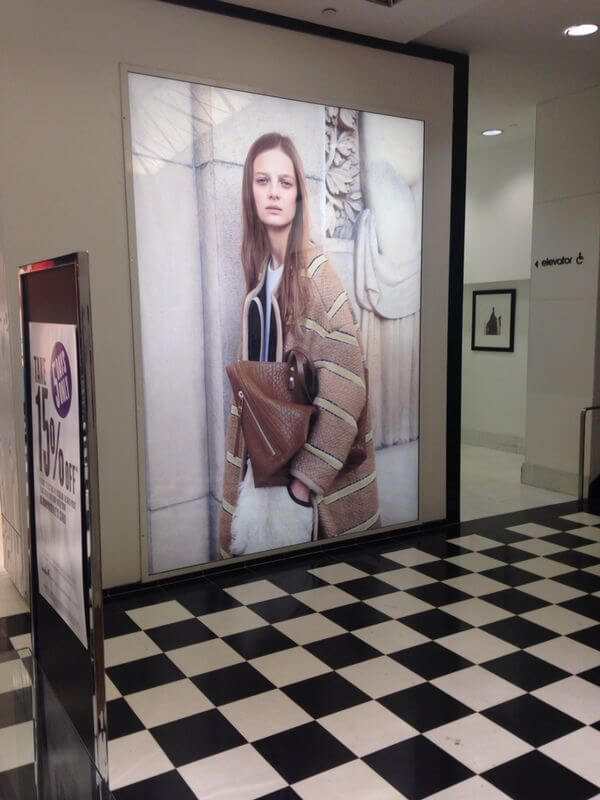
Light Box Signs in New York
Illuminated light box signs for storefronts, restaurants, retail interiors and commercial spaces. Wall-mounted and projecting, single and double-sided, standard cabinets, push-through faces and fabric lightboxes. LED-lit, evenly bright, and built so the face can be changed and the lighting serviced without taking the sign down.
New signs, new faces on old cabinets, and LED upgrades for tired fluorescent boxes.
Decide what glows
A classic lightbox lights its whole face. A white panel with dark lettering glows as one bright rectangle, and after dark that rectangle is what people see. Sometimes that is exactly right. Sometimes the name is lost in the glare.
The better question is not whether a sign is lit, but which part of it is lit. On one sign, the whole panel should glow. On another, the face should stay dark with only the letters and logo lit. The cabinet can look almost the same in daylight and completely different at night.
That single decision shapes the face material, the graphics and the cost, so we make it first. The rest of the sign follows from it.
Types of light box signs
| Type | What it is | Usually for |
|---|---|---|
| Standard cabinet | An aluminum box lit from inside, with a translucent face carrying the graphics. The whole face glows. | Storefronts, fascia signs, bold and legible branding. |
| Push-through | A solid aluminum face with the letters cut out and acrylic letters pushed through. Only the letters glow. | Storefronts wanting a refined look at night. |
| Routed face | A solid metal face with the letters cut out and backed with translucent material. Only the letters glow, flush with the face. | A cleaner, lower-cost version of push-through. |
| Shaped cabinet | A cabinet built to a circle, oval, logo outline or other custom shape. | Logos and brand shapes that do not suit a rectangle. |
| Double-sided | Two faces back to back, often projecting from the wall. | Blade signs readable from both directions down the street. |
| Flex face | A tensioned vinyl fabric face on a large frame. | Large signs where a rigid face would be too big or too heavy. |
| Fabric lightbox | A slim frame with a printed fabric graphic tensioned into a channel. | Indoor retail walls, displays, lobbies and events. |
| Menu boards | Backlit panels with changeable menu graphics. | Restaurants, cafes and counters. |
What the light shines through
The face and its graphics decide how the sign looks both lit and unlit. They are also the parts most likely to be replaced over the life of the sign.
| Face | Worth knowing |
|---|---|
| Polycarbonate | Highly impact-resistant, so it is the usual choice for outdoor faces within reach of the street. |
| Acrylic | Clearer and more rigid, with crisp color. It can crack on hard impact, so it suits faces out of reach or indoors. |
| Flex-face vinyl | Tensioned fabric for very large faces. It is lightweight and can be replaced in one piece. |
| Tension fabric | Printed textile for indoor lightboxes. It is lightweight and quick to swap. |
- Translucent vinyl. Colored translucent film cut and applied to the face. Durable and consistent, and good for simple logos and lettering.
- Printed graphics. Full-color printing on translucent film or directly on the face, for photos, gradients and complex artwork.
- Day and night. A print that looks right lit can look dull unlit, and the reverse. Graphics can be printed so they read well both ways, and we check color under light before the full face is made.
- Brand colors. Colors look different lit from behind than on paper or on screen. We match them in lit samples, not only on a proof.
Even light, not bright spots
The most common fault in a lightbox is uneven light: bright spots where each LED sits, dark corners, or a band of shadow across the middle. It shows at night, and it makes a new sign look cheap.
- Spacing and depth. How evenly the face glows depends on how the LEDs are spaced and how deep the cabinet is. A shallow cabinet needs its LEDs placed more carefully.
- Backlit or edge-lit. Backlit cabinets have LEDs on the back panel shining forward. Edge-lit panels feed light in from the sides through a diffuser, which allows a much slimmer sign, mostly used indoors.
- Brightness for the setting. A sign on a bright avenue needs more light than one on a quiet side street or inside a shop. Too bright looks harsh and can draw complaints from neighbors.
- Controls. Timers, photocells and dimmers switch the sign on at dusk, off at closing and adjust its brightness, instead of relying on someone to remember.
- LED over fluorescent. LED light box signs use less power and last longer than fluorescent tubes. They also run cooler and give a more even light.
Outdoor light box signs
- Built for the weather. Sealed seams, gaskets and small drainage holes, so water that gets in can get out instead of pooling around the electrics.
- Impact-resistant faces. Polycarbonate faces for signs within reach of passersby or delivery trucks.
- Listed components. Illuminated outdoor signs are generally expected to use listed electrical components and carry a UL listing.
- Permits and zoning. In New York City, most exterior illuminated signs need a sign permit and an electrical permit, and zoning can limit illumination, size and projection. Projecting double-sided signs have their own limits. More on this is on our signage company page.
- Power at the wall. A circuit near the sign, ideally on a switch or timer. Tell us if one is already there.
Indoor light box signs
- Slim and light. Indoor lightboxes can be far thinner than outdoor cabinets, especially edge-lit and fabric designs.
- Graphics that change. Fabric lightboxes let retail and brand spaces swap campaigns in minutes by changing the printed fabric.
- Menu boards. Backlit menus with changeable panels for restaurants and counters.
- Brand walls and lobbies. Backlit logos and images for reception areas, showrooms and retail walls.
For campaign displays and in-store merchandising, see our POP displays page.
Built to be opened, not replaced
A commercial light box sign usually outlives its first face. The business rebrands, the graphics fade, or a new tenant takes over the storefront. A good cabinet makes all of that simple.
- Faces that come out. Retainers or hinged frames let the face be removed and replaced without taking the cabinet off the wall.
- Re-facing. A new face on an existing cabinet is often the quickest and least expensive way to rebrand a storefront.
- LED retrofits. Older fluorescent cabinets that are still structurally sound can often be converted to LED lighting, with new internal lighting and power supplies.
- Serviceable parts. LED power supplies can fail before the LEDs do. We place them where they can be reached from the face or a service panel.
- Cleaning. Dust and insects inside the cabinet dim the light over time. An opening face makes cleaning part of normal maintenance.
Photo to lit sign
- Send us the frontage or the wall. A photo, the address, rough dimensions and your logo. Tell us if there is an existing sign or power.
- Four questions. Indoor or outdoor? Whole face lit or only the letters? Single or double-sided? New cabinet or new face on an old one?
- Drawing. The sign drawn to scale in place, with the cabinet, face, graphics, lighting and mounting specified.
- Lit sample. A sample of the face and graphics, lit, so you see the colors as they will look at night.
- Fabrication. Cabinet built, LEDs and power supplies installed and tested, face finished.
- Installation. Mounted, connected, and switched on to check the light is even, with timers or controls set up.
Light box signs that look right after dark
| Capability | What it means for your sign |
|---|---|
| We decide what glows | The whole face or only the letters, chosen for how the sign should look at night. |
| We light it evenly | LED spacing and cabinet depth designed to avoid hot spots and dark corners. |
| We sample under light | Brand colors checked lit, not only on paper. |
| We build for service | Faces that open and power supplies you can reach. |
| We re-face and retrofit | Existing cabinets reused with new faces or LED lighting where they are sound. |
| We handle the storefront | Light boxes, awnings and other signs can come from one team. |
Frequently Asked Questions About Light Box Signs
What is a light box sign?
A light box sign is a cabinet, usually aluminum, lit from inside, with a translucent face carrying the graphics. Light shines through the face so the sign is visible after dark. Variations include push-through and routed faces, where only the letters glow, and slim fabric lightboxes for interiors.
Are LED light box signs better than fluorescent?
For most signs, yes. LEDs use less power, last longer, run cooler and give a more even light when properly spaced. Many older fluorescent cabinets can be converted to LED if the cabinet itself is still sound.
Can you replace just the face of our sign?
Often, yes. If the cabinet is structurally sound and the lighting works, a new face with new graphics is a common way to rebrand a storefront or update a sign for a new tenant.
Do outdoor light box signs need a permit in NYC?
Most exterior illuminated signs in New York City need a sign permit, and the electrical work needs its own permit. Zoning can also limit illumination, size and projection. Send us the address and we will tell you what to expect.
Should the whole face light up, or just the letters?
It depends on the look you want at night. A fully lit face is bold and highly visible. A push-through or routed face, where only the letters glow, looks more refined and avoids a large bright rectangle. We can show you both options before you decide.
Single or double-sided?
A wall-mounted sign is usually single-sided. A projecting sign that sticks out from the facade is usually double-sided, so it can be read from both directions along the street.
Can indoor lightbox graphics be changed easily?
Yes. Fabric lightboxes use a printed textile graphic tensioned into the frame, which can be swapped in minutes. They suit retail campaigns, displays and events.
What do you need for a quote?
A photo of the location, the address, rough dimensions, your logo, and whether the sign is indoor or outdoor. Tell us if there is an existing sign or power supply at the location.