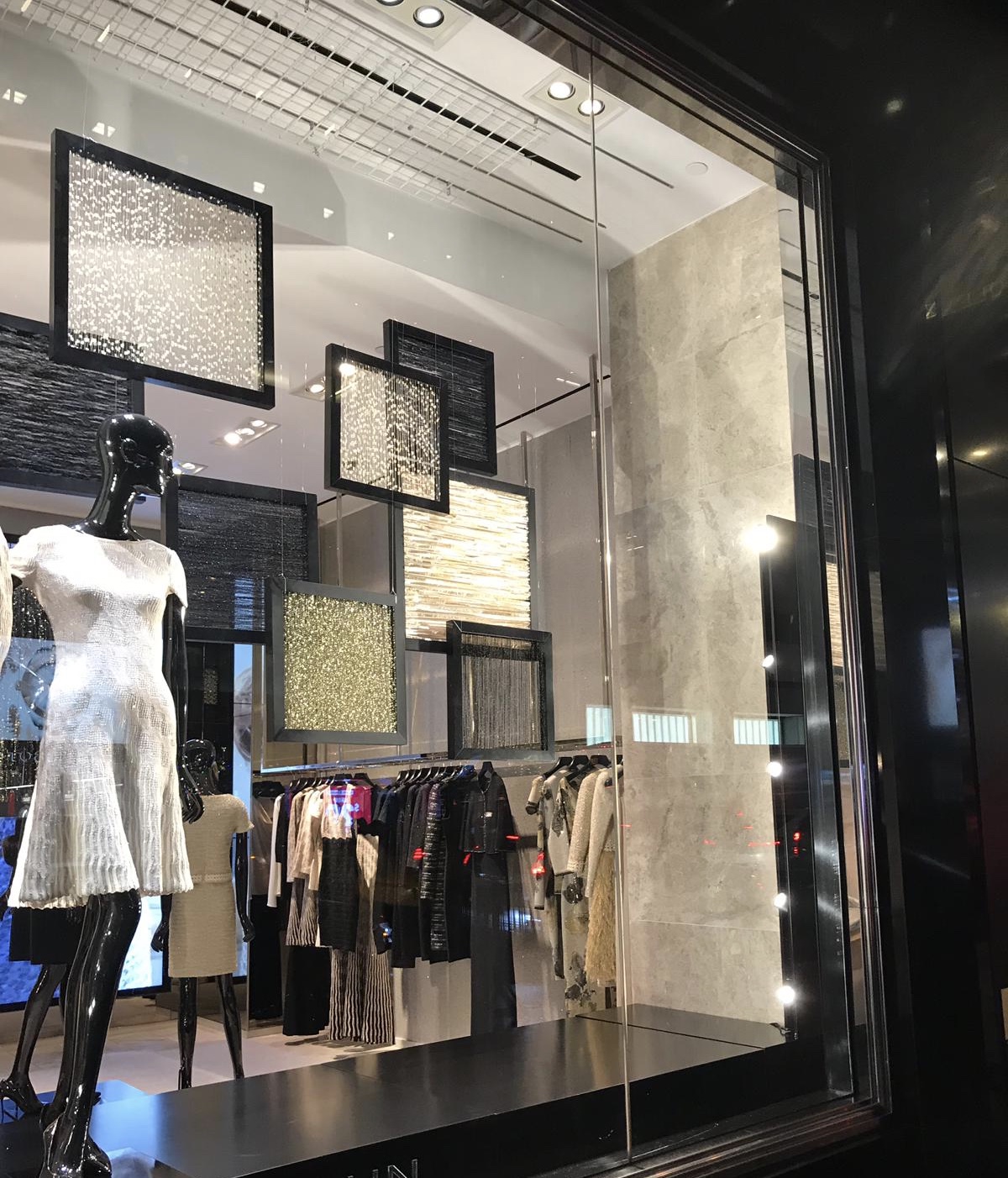
Window Display Design in New York
Velement designs, fabricates and installs store window displays across New York City. Backdrops, risers, props, product staging, printed graphics and lighting, designed as one scheme and built in our own workshop.
Seasonal campaigns, product launches, flagship windows and multi-store rollouts. Design through installation, including overnight fits so the store opens on time.
The most valuable advertising space a store owns is the one it already pays rent on
A shop window is billboard space that comes free with the lease. It works on every person who walks past, whether or not they were looking for you, at every hour the street is busy, with no media spend attached to it. In most of New York it is also the only part of the store a passer-by ever sees.
What separates a window that works from one that does not is rarely budget. It is whether the window was designed for the way people actually encounter it: at a distance first, in motion, with a second and a half of attention, and only then, if something has earned it, up close at the glass. Windows that fail usually fail because they were designed flat, on a screen, to be looked at straight on from six feet away. Nobody ever sees them that way.
Velement designs windows for how they are seen, and then builds them. We print the graphics, fabricate the risers, backdrops and fixtures, specify the lighting and install it, usually overnight, so the store opens the next morning with the window finished.
The parts of a window, and who makes them
| Element | What it does | What we make it from |
|---|---|---|
| Backdrop or back wall | Closes the window off, hides the store behind it and gives the display a controlled background. | Tension fabric on a frame, printed panel, or a built and painted wall. Fabric wins where the graphic changes often. |
| Risers and platforms | Lifts product off the floor into the eye line and creates the height differences that make a window read as composed rather than flat. | Acrylic, painted MDF or fabricated metal, in a standard set of heights that can be reused across campaigns. |
| Props and set dressing | Carries the idea. The part people remember and photograph. | Fabricated to the design in acrylic, metal, board or mixed materials. |
| Printed graphics | The headline. What gets read from across the street. | Large-format print on display polyester, board or applied film. |
| Glass graphics | Anything applied to the window itself: type, patterns, frosting, promotional messaging. | Printed and cut vinyl. Handled by our store window graphics team. |
| Lighting | Makes the whole thing visible after dark and competitive with daylight before it. The most commonly under-specified element in the window. | Track and spot fittings, concealed LED, light boxes and illuminated elements. |
| Mannequins and forms | Presents apparel and soft product at the right height and angle. | Sourced and dressed. Usually the client’s own stock. |
Open-back and closed-back windows
Worth deciding early, because it changes the design and the cost.
| Aspect | Closed-back | Open-back |
|---|---|---|
| What it is | A solid backdrop separates the window from the store. | The window is open to the shop floor behind it. |
| Advantage | Complete control of the background and the lighting. The display reads as a composed image. | Daylight reaches the shop floor and passers-by can see into the store, which matters for footfall and for feeling open. |
| Constraint | Blocks light and the view into the store. Uses floor area that could be selling. | The display has to work from both sides and compete with everything visible behind it. |
| Usually used by | Fashion, jewelry, flagship and campaign-led retail. | Food, convenience, service businesses and smaller footprints. |
Design for how a window is actually seen
A window display is read three times by the same person, at three distances, and each read has to do something different. This is the single most useful thing to understand about window design and it is why windows that look good as artwork often fail on the street.
| Distance | What the viewer is doing | What the window has to do |
|---|---|---|
| Across the street, 30 to 60 feet | Walking, not looking. Peripheral vision only. About one second. | One strong shape, one dominant color, one legible word. If there are three messages, none of them land. |
| Approaching on the sidewalk, 10 to 30 feet | Has noticed. Deciding whether this is for them. Two to four seconds. | The composition reads: what kind of store, what is on offer, what the idea is. Height differences and negative space do the work here. |
| At the glass, under 6 feet | Stopped. Looking at product. As long as it holds them. | Detail, product, price, texture, finish. This is where poor fabrication shows and where the decision to walk in is made. |
Most failed windows are designed only for the third distance. They are full of detail that cannot be read from anywhere except the glass, and from across the street they read as visual noise. We design from the furthest distance inward.
The half of the window most budgets forget
A window display competes with daylight during the day and with every other lit frontage on the street at night. Store interior lighting levels are not enough for either. A display lit to the same level as the shop floor behind it will look flat by day and disappear by night, and no amount of design fixes that.
- Levels. A window needs noticeably higher light levels than the interior behind it, or it reads as a dark box in a bright shop.
- Angle. Fixtures have to be positioned so they light the product and not the glass. Badly aimed lighting produces reflections that make the window unreadable from the street, which is the most common lighting fault we are called in to correct.
- Daylight. Sunlight through the glass changes through the day and through the year. A south-facing window is a different lighting problem from a north-facing one, and both are different in December and June.
- After hours. Lighting is what the window looks like for the twelve hours nobody is in the store. If the display budget has to be cut somewhere, it should not be here.
A window display system costs less than four window displays
Most retailers change their windows four to six times a year, and most pay to build a new one every time. The alternative is to build a system: a reusable structure and a set of standard components that stay, with only the graphics and the props changing each campaign.
| Approach | What happens each campaign | What it costs |
|---|---|---|
| Build new each time | Design, fabricate, install and dispose of a complete window. | The full build cost, four to six times a year, plus disposal. |
| Build a system (recommended) | The frame, backdrop structure, risers and lighting stay. New graphics are printed, new props are made, the window is redressed. | The full build cost once, then a materially smaller cost per campaign. The saving compounds across multiple stores. |
When windows change
| Cycle | Typical timing | What drives it |
|---|---|---|
| Seasonal | Four to six changes a year | Spring, summer, fall, holiday. The backbone of the calendar. |
| Holiday and peak | A dedicated build, often the largest of the year | The window that has to work hardest. Usually planned months ahead. |
| Product launch | As required | Driven by the brand, not the calendar, and usually on a fixed date. |
| Promotional | Frequent, short-lived | Handled with graphics and glass vinyl rather than a rebuild. |
A shop window is a harder environment than it looks
| What happens | Why | What we do about it |
|---|---|---|
| Print fades | Direct sunlight through glass is concentrated and constant. A graphic that lasts years on a wall can shift noticeably in a single summer in a south-facing window. | UV-stable inks and media specified for the orientation of the window, not as a single default. |
| Board warps and bows | Heat builds up behind glass, particularly in a closed-back window with no airflow. | Materials and construction chosen for the heat the window actually gets, with rigid substrates where a panel has to stay flat. |
| Colors shift between elements | Printed graphics, painted props and vinyl on the glass are three different processes, and matching across them is not automatic. | All three printed and finished in one workshop, matched to the same reference. |
| The display looks good and the glass looks dirty | Fingerprints and street grime sit on the surface the customer looks through. | Not a fabrication issue, but worth building into the store’s routine. A clean window is the cheapest improvement available. |
| Reflections make it unreadable | Lighting aimed at the glass rather than the product, or a bright element opposite the window. | Fixture positions set on site rather than on the drawing. |
Velement prints window graphics on durable display polyester with odorless ink, which matters more than it sounds: displays are installed overnight in an occupied store, and a fresh print that smells is a problem the store manager has to explain to customers the next morning.
From brief to open the next morning
- Site visit. We visit the window, measure it, photograph it by day and after dark, note the orientation, the sightlines and what is opposite it. A window is a specific space, not a set of dimensions.
- Concept. You give us the campaign, the product and the budget. We come back with a concept, shown as a visual in your own window rather than as a mood board.
- Design and specification. Materials, structure, lighting and fixings specified and drawn. This is where a reusable system is designed, if that is the route.
- Fabrication. Graphics printed, structure and props fabricated, everything assembled and checked in our workshop before it leaves.
- Installation. Usually overnight or before opening. The store opens the next morning with the window finished and the space clear.
- Changeover and storage. For clients on a campaign cycle, we hold the system and the specification so the next change is a redress rather than a new project.
Design, print and fabrication in one place
| Capability | What it means for the project |
|---|---|
| We design | The concept comes from the people who will build it, so what you are shown is what can actually be made to the budget. |
| We print | Graphics are produced in house on display media, matched to the printed and painted elements around them. |
| We fabricate | Backdrops, risers, props and fixtures are made in our own workshop, including acrylic fabrication and store fixtures. |
| We install | Our own crews work overnight or before opening so trading is not affected. |
| We work to a calendar | For retailers changing windows four to six times a year, we hold the system and the specification between campaigns. |
Frequently Asked Questions About Window Display Design
What is window display design?
Window display design is the design and construction of the display inside a shop window: the backdrop, the risers and platforms that stage the product, the props that carry the idea, the printed graphics, and the lighting that makes all of it visible. It is distinct from window graphics, which are printed films applied to the glass itself.
How much does a store window display cost?
It depends on the size of the window, whether it is open or closed-back, how much is fabricated and whether the structure is reusable. A single promotional window using graphics and existing fixtures is modest. A full closed-back build with custom props, lighting and a fabricated backdrop is a project. The most useful question is usually not what one window costs but what a year of windows costs, because a reusable system changes that number substantially.
How often should we change our window display?
Most retailers change four to six times a year, aligned to the seasons with a larger build for the holiday period, plus promotional changes in between that are handled with graphics rather than a rebuild. The right number depends on your footfall: a window on a street people walk down daily needs changing more often than one on a destination street.
Can you install without closing the store?
Yes. Most of our window installations are done overnight or before opening, so the store trades normally and opens the next morning with the window finished.
Do you design as well as build?
Yes. We design the display, produce the graphics and fabricate the structure and props in our own workshop, then install it. Clients who already have a design from their own team or agency can bring it to us to build.
What is the difference between window display design and window graphics?
Window display design is what sits behind the glass. Window graphics are printed and cut films applied to the glass itself: promotional messaging, patterns, frosting and one-way vision. Most window projects use both. See our store window graphics page for the glass work.
Can you roll out the same window across several stores?
Yes. We hold the design and the specification and produce identical or scaled versions for each location, which is how multi-site retailers keep windows consistent without commissioning each store separately.
Will a window display fade in the sun?
Printed graphics in a sunlit window fade faster than the same print anywhere else, because the sunlight is direct, concentrated and constant. We specify inks and media for the orientation of the specific window rather than using a single default, which is why a south-facing window is quoted differently from a north-facing one.
View Our Projects